Happy holidays to everybody who got their's today! At my school, we finished with the children a week ago and have had almost finished an intense week of POI reviews and collaborative planning with the staff. Here's how we finished off the school year this time last week..... with a MASSIVE water fight!
Friday, 26 June 2015
Tuesday, 23 June 2015
Making your central idea child-friendly
I know there are lots of IB PYP teachers out there who have very "wordy" central ideas. I have heard lots of teachers ask the question, "How do I make my central idea easy for children to understand?"
Here are two examples of how my class breaks down the central idea at the start of every unit of inquiry:
Friday, 12 June 2015
10 things to which teachers can bid farewell for the summer
1. Clean versions of swear words:
Now when you drop something, you don't need to say, "Shi... sugar!"
2. Early morning alarms:
Early mor... What is this thing of which you speak? Oh yeah, that thing I don't have to do this month... or next month!
3. PAPERWORK:
Sweet, glorious relief! Not a lesson plan in sight!
4. Packed lunches:
No more eating out of plastic containers. You now have the luxury of eating things that haven't been sitting in the staffroom fridge all morning.
5. Making ridiculous threats like this:
6. Remembering (or caring about) what day it is:
Now when you drop something, you don't need to say, "Shi... sugar!"
| image source |
Early mor... What is this thing of which you speak? Oh yeah, that thing I don't have to do this month... or next month!
![]() |
| image source |
3. PAPERWORK:
Sweet, glorious relief! Not a lesson plan in sight!
![]() |
| image source |
4. Packed lunches:
No more eating out of plastic containers. You now have the luxury of eating things that haven't been sitting in the staffroom fridge all morning.
![]() |
| image source |
5. Making ridiculous threats like this:
![]() |
| image source |
In your own little bubble, it doesn't matter!
7. Styling your clothes, hair or make-up in a child-friendly way.
8. Having friends with any other profession:
![]() |
| image source |
7. Styling your clothes, hair or make-up in a child-friendly way.
Go on, dye your hair green, lash on the eyeliner and get those legs out!
![]() |
| image source |
8. Having friends with any other profession:
Naturally, you'll get a lot of stick for having no work for weeks on end while your (once) friends slave away.
![]() |
| image source |
9. Staying in on weeknights:
No more, "Oh I can't stay up past 11pm or I won't have any energy for my class."
![]() |
| image source |
10. Accidentally speaking to other adults as if they're children:
Once you're out of teacher-mode, it's much easier to avoid a big fake, "Wooowwwww!" when a friend says something mildly interesting to you. You're sure to notice a decline in how patronising you can be as you gradually get used to adult company.
![]() |
| image source |
Friday, 5 June 2015
Free end of school year resources and ideas
For the little ones:
Have a teddy bears' picnic. It doesn't have to involve too much organisation. They could just eat their normal school lunch and do it at a different time and with their favourite teddy bears in tow. If it's dry, it could be a treat to eat their snack on blankets on the grass. If not (for my Irish teacher followers, this is the more likely option once the Leaving Cert weather is over!), you could just clear a space in the classroom and put down the blankets there. They could read "We're Going on a Bear Hunt" and sing "Teddy Bears' Picnic" and the horrifically catchy, "Yogi Bear Song" - WARNING: Do not, UNDER ANY CIRCUMSTANCES show any video entitled "Yogi Bear Song" on YouTube without listening it to yourself first. There is a very non-child-friendly version out there!
For the older children:
"I Am" poem to get them reflecting about their personal characteristics, strengths and characteristics from Who's Who and Who's New.
| Image source |
![]() |
| Image source |
Introduce your children to these inspirational quotes (from Jason's Online Classroom). They can then design a poster to write them beautifully and illustrate accordingly. They could be used as a writing prompt so that their story uses the quote as its core.
![]() |
| Image source |
A table quiz. I'm a self-confessed quiz nerd and am quite happy to ramble off table quiz questions off the top of my head. If you need a bit more guidance, why not use a ready-made quiz like Seomra Ranga's wonderful art quiz (on PowerPoint, created for Digital Art Week but could be tweaked to make it suitable for your needs - non-Irish teachers, there are some questions you might want to change/remove) or this one from The Telegraph (answers are here).
For younger and older students:
A "field trip" to the next grade. Your children think of questions they would like to ask to children in the class above them. Then they go to that classroom and find out the answers from the "experts." What a fantastic idea from Melissa at Inspire Me ASAP.
![]() |
| Image source |
Going the other way, this end of year book allows your current students to give advice to incoming students. It's a great way for your students to reflect on what they have learned and it's a lovely thing to begin the school year with if you have the same class level.
![]() |
| Image source |
Orienteering around the school grounds. I've created a resource pack with instructions on how to set it up and carry it out and the resources needed. All you have to do is make a map of your school grounds, stick the clues around and hand out the students' sheets. Click here to download it for free from Google Drive.
Superlative Olympics. This is a game I have used to teach comparatives and superlatives to children with English as a second language in summer camps. I made my own cards to go with the game. Click here to read my blog post about how to play. It's suitable for primary school children of all ages and it's loads of fun! Click here or on the image below to download the resources for free from Google Drive.
This summer writing activity from Educating Everyone 4 Life:
![]() |
| Image source |
Create a wordsearch with all of your children's names in it. Thanks to Jordon at The Half Full Cronicles for this idea.
![]() |
| Image source |
One of my favourites is to create a maths table quiz to revise the topics you have covered in the year. I put different maths questions on a PowerPoint/Keynote presentation, split the children into teams of 3 or 4. They love working together to solve the problems. Just make sure you put in a few really tricky ones to get them really engaged!
| Image source |
Have an end of year compliments box. All you need is a box/basket, small pieces of paper and an envelope for each child. Obviously, it would be better to do it a day before they take them home so that you can read them and make sure there is nothing bad in there. Here's a ready-made compliment kit to get you started.Thanks to Blair Turner for creating it.
![]() |
| Image source |
*The clip art in main image is from My Cute Graphics
Monday, 1 June 2015
On buying something I didn't need
I have a problem. I really do. I can't seem to resist anything purple and owl-patterned. Combine the two and there's no escaping!
Over the Easter holidays, I was back in Ireland, trawling through Penney's (that's Primark for my non-Irish readers), ready to fill the rest of my suitcase to the 15kg weight limit. I stumbled upon this lovely purple, owl-patterned coffee flask. It was only €3 - a steal! Just look how cute it is!
That all seems pretty normal, doesn't it? The problem is that I don't drink coffee... or tea... and there's no way I'd bring hot chocolate anywhere in the flask. So that renders it pretty much pointless for me. I put it up on top of my microwave so I could admire it in the kitchen. Again, still pointless! Then I had an idea... Why don't I turn it into a pen holder?
Ah I see, the pens are lost in there. It wouldn't be easy to get them out.
Then I thought for a minute, bounded over to the recycle bin and returned with a scrunched up ball of paper.
Bam! Problem solved! Now my pens are easily grab-able!
After having written this post, I'm not sure how much more enriched your life will be by my earth-shattering revelation. By all means, if any of you do pop down to Penney's (or Primark) and make a pen holder out of a coffee cup for your home or classroom, be sure to comment with a picture!
Saturday, 23 May 2015
Plant Life Cycles - free resources and ideas
In this post I have to give a big shout out to Sparklebox. Sparklebox has almost single-handedly saved me hours of planning and resource preparation time.

This week the children have been learning about life cycles of plants. This section of Sparklebox had more than enough resources to keep my children VERY BUSY this week. I just had to print, cut and laminate. Another great resource, was this cut and paste activity from Teachers' Pet . They have three differentiated versions but it's only available to premium members (£15 for a year's subscription).
Anyway, here are some pictures of what we got up to during the week:
We did an experiment to see how cress seeds would grow with or without water. It was very simple. All you need are cress seeds, cotton wool, two cups and felt tips to write on the cups. We used this Sparklebox cress booklet to document equipment used, predictions and daily growth (or lack thereof) in the two cups. At the end, there's also a section for a mini conclusion.
The children LOVED this experiment to bits. They were so excited to watch how quickly their plants grow. They've all taken them home with the suggestion of making an egg and cress sandwich over the weekend!
I split the children into 4 groups and gave them pictures (from Sparklebox) of the parts of the life cycles of either a potato plant, an apple trea, a bean plant or a dandelion. They sequenced these together and then independently drew the life cycle and wrote what was happening at each stage into their language books. Then, as a group, they made a big poster of their plant's life cycle to share at assembly next week.
Then the children used these wonderful playdough mats (again from Sparklebox) that show 6 stages of the life cycle of a flowering plant. They worked with a group to create a playdough model of the seed/plant in each stage. Then they filmed the playdough mat as they read the description of each part. Finally, they used iMovie to put them all together into one video file.
Saturday, 16 May 2015
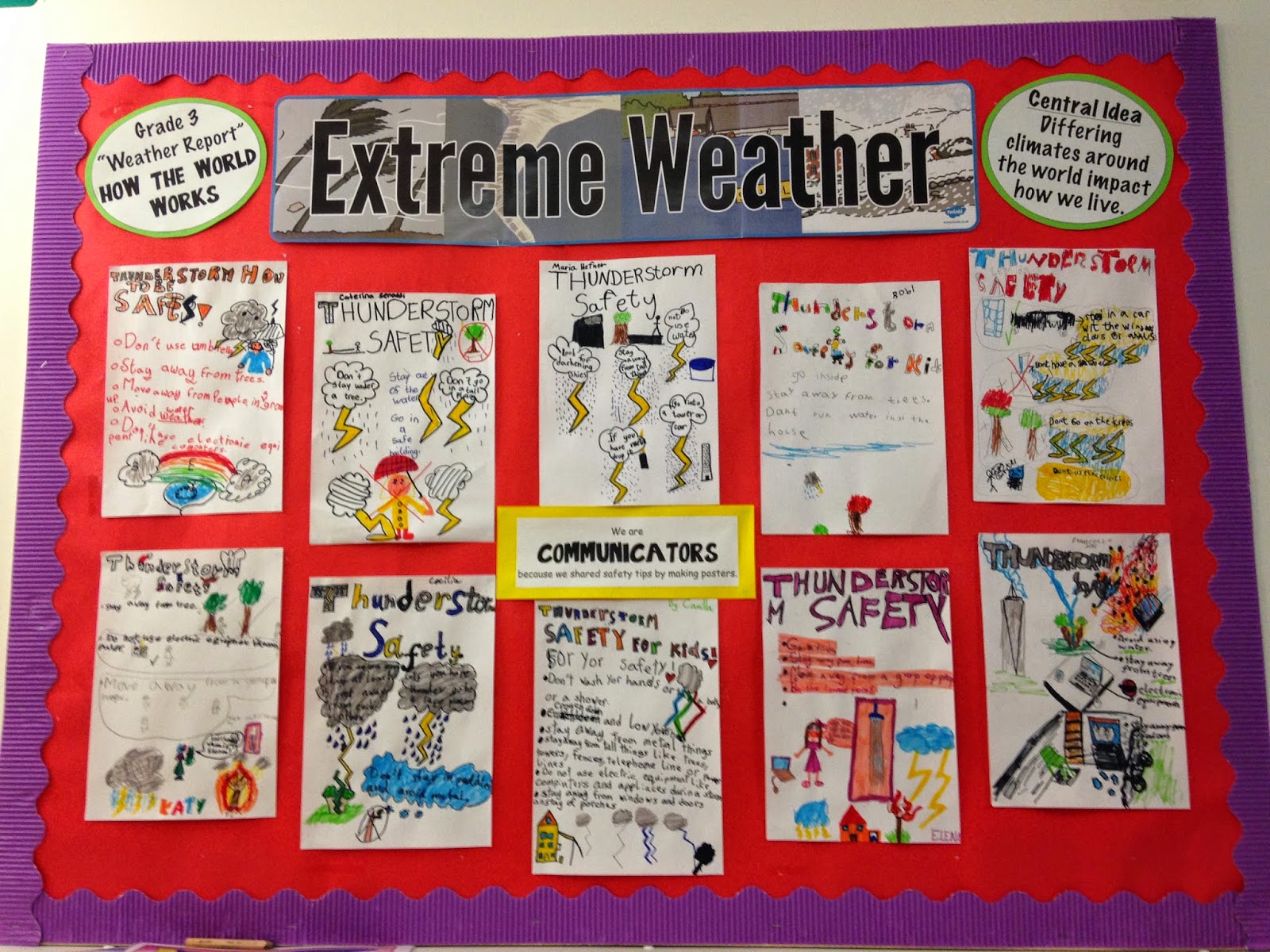
Our "How the World Works" unit of inquiry in pictures
My class has recently finished their fifth PYP unit of inquiry, under the transdisciplinary theme of "How The World Works." Our central idea was "Differing climates around the world impact how we live."
Here are a few pics of some things around the classroom by the end of the unit. Have a look back a few posts to find some more of the resources we used.
Subscribe to:
Posts (Atom)