Showing posts with label english. Show all posts

Thursday, 17 August 2017

Children's books with strong female characters

If you're thinking about stocking up your school/class library, be sure to include some books that have strong female role models. Here are my top picks!

Good Night Stories for Rebel Girls (by Elena Favilli):
One of the children in my class (a 7 year old) brought in this bestseller for Show and Tell this year. She spoke about it with such enthusiasm and many of the others in the class said that they have the same book and love it too. The book features famous, inspirational women from Queen Elizabeth to Serena Williams and many more strong role-models in between.


Women in Science: 50 Fearless Pioneers Who Changed the World: (by Rachel Ignotofsky):
Another bestseller, this book tells the stories of influential women in the STEM (Science, Technology, Engineering and Mathematics) world. It is beautifully illustrated and very informative. Since its release it has received rave reviews from parents and teachers.


Bad Girls Throughout History: 100 Remarkable Women Who Changed the World (by Ann Shen):
In a similar fashion to Elena Favilli's "Good Night Stories for Rebel Girls", this book tells the story of many influential women throughout history such as Amelia Earhart, Cleopatra, Marie Curie and even Joan Jett, the godmother of punk. Again this is beautifully illustrated and presented in a way that is accessible to many age levels (though it may need to be read aloud to younger children).


Fantastically Great Women Who Changed the World (by Kate Pankhurst):
This one is much more child friendly in terms of layout and illustrations than the above situations. The text is laid out in smaller chunks making it less intimidating to younger eyes! It has been tried and tested by several parents and teachers and it has been enjoyed by children as young as 4 or 5. This book features bright, engaging pages about strong female characters such as Anne Frank, Coco Chanel and Rosa Parks.

.....Aaaaaaand here are a few more for you to check out:
"Matilda" by Roald Dahl
"Pippi Longstocking" series by Astrid Lindgren
"Ronia the Robber's Daughter" by Astrid Lindgren
"The Princess in Black" series by Shannon and Dean Hale
"Zita the Spacegirl" series by Ben Hatke
"Island of the Blue Dolphins" by Scott O'Dell

Be sure to check out the jam-packed website, "A Mighty Girl" and The Guardian's list of 10 books featuring empowering female characters for lots more ideas!


Tuesday, 23 May 2017

Tech Tip Tuesdays: Worthwhile purchase -a clicker

Welcome back to another Tech Tip Tuesday. Click here to view any of the other posts in this series. As always, if there are any technology tutorials that you'd like me to feature, be sure to comment below!

This week's post is a recommendation for a simple tool and how it can be used in your teaching.


This little thing has proven to be very useful over the years. I got it cheaply on Amazon and it has been worth every cent! Don't worry, this isn't going to be a post about clicking through a PowerPoint full of information text. Here are some practical ways to use it in the classroom.

Student presentations:
In my school, it's not uncommon to see children doing oral presentations making use of a Keynote/PowerPoint presentation. You'd be amazed to see the boost of confidence they get when the clicker is placed in their hands!
Teaching new vocabulary (great for ESL/other second language):
I absolutely love having my students play Kim's game (known to Irish teachers as Cluiche Kim) to teach new vocabulary in another language. It's very simple. Pick 5 new words and put their pictures on slide 1. Then copy and paste that slide several times. On slides 2, 4, 6, etc. delete one of the pictures (moving the position of the other pictures or deleting more than one picture at a time if you want to create an extra challenge). Simply use the clicker to make the board blank, have your students close their eyes and then click to the next slide. They then need to name which picture is missing. 

Student selection:
Many of these pointers have a laser on the top. Children LOVE using these! It could be used for phonics. Put a sentence / several words on the board and ask a child to use the pointer to show the "ch" sound. Similarly, it could be used to point at the photograph representing a new word in another language. They could use it to show where they found a word on a Boggle board (with letters or numbers - if you don't know what I'm on about, Google "Math Boggle"). 

Behaviour management aid:
If you happen to use PowerPoint/Keynote for any of the above ideas, this clicker allows you to use the classroom management strategy of proximity, ie. standing close to the children who are likely to misbehave (or have already begun misbehaving!). You can still play the games or go to the next slide of a text from any corner of your classroom. This gives you endless freedom to keep a close eye on those who need it!

Credits for Tech Tip Tuesday logo:
Keyboard lettering  licensed by Dancing Crayon Designs ©www.dancingcrayon.com 
Glittery clip art from Glitter Meets Glue Designs 

Clip art frame from My Cute Graphics

Monday, 19 September 2016

Question word posters freebie

Ahoy there!

I have just added a freebie to my TPT store. It's this set of questions posters. 


I'm going to have my class fill the blank spaces with answers to these questions. Alternatively, you could get the children to put examples of questions using these words. This makes the display much more meaningful for the class.

Enjoy!

Saturday, 5 March 2016

Book Week Ideas, Displays and Activities

Hi everyone,

I was really inspired by the photos and ideas shared for World Book Day last Wednesday. If you're having Book Week at your school later this year, here are some of my favourite displays/ideas.

If you have any more, please free to add them in the comments!

Shelfie Competition: 
This one was shared on Twitter by Aileen Brennan Nevin (@leenbre). The idea is that the teachers take a photograph of their book shelf. The photos are numbered and the children can enter by guessing which teacher owns which shelf. The first correct entry picked from the entry box could win a prize (ideally a book!).
Image source
Decorate your classroom doors as book covers: 
Get the children to write their own Biff, Chip and Kipper book:
Oxford Reading Tree is hosting a writing competition to celebrate their 30th birthday. The closing date is 30th April 2016. Perhaps you could do this during Book Week. Even if your school is not eligible to enter, why not download the template and do it just for fun! Check out more details about the competition here.


Dress up as your favourite book character:
The Guardian has a gallery of some great costumes from World Book Day 2016. Here are two of my favourites.
Aliens Love Underpants
image source

Willy Wonka
image source

Have the older children read to the younger children:
Pair up the classes and let the older children read to the younger children. This is a lovely one for building confidence as the books will be easy for the older children to read.
image from My Cute Graphics
Create an "Our Favourite Books" corner:
Ask everyone (teacher and children) to bring in their favourite book to keep in school for the week. Create an "our favourite books" corner in the classroom which they can read one another's books during the week.

image source: JPS Books

Invite parents to read to the children:
We have done this in our school and invited parents to read in their native languages even if it's not English. The children love it!
image source: PBS Parents

Make some book marks:
I particularly love these monster/owl ones from Red Ted Art. Click here to view the video tutorial on how to make them.
image source: Red Ted Art

Self/peer-assessment of reading aloud:
Model how to use this self/peer-assessment sheet. Then split your class into pairs and let them assess their own reading and that of their classmates. You can download this sheet for free from Google Drive by clicking here or on the image below.


Display famous quotes from books:
You could create a display board of famous quotes from books. Twinkl has a ready-made pack (see image below) but you could also get the children to choose their own favourite quote to decorate.
image source: Twinkl 


 Carry out an author study:
You could ask older classes to do this individually or you could do it as a whole group activity. Here's a nice (free) graphic organiser from Jessica Lawler.
image source TPT: Jessica Lawler's store

Do a book scavenger hunt:
There are lots of different versions you could do. Here are some examples.
image source: Amanda on Writing (Tumblr)

For older children, this "non-fiction features" scavenger hunt from Buzzing With Ms B is great. Click here to view her blog post about it and download it for free.

image source: Buzzing With Ms. B
This one from Twinkl is based on finding specific words/pictures.


Saturday, 27 February 2016

Criminal words - overused words - display

We're working on storytelling lately and I wanted something to help build the children's vocabulary and make their writing more interesting. I thought this was a lovely display idea with substitutes for overused words. You can download the banner and the word mats for free from Teacher's Pet. They also have editable "swag bags" so the children can generate their own substitutes and write them on coins. 


Tuesday, 25 August 2015

Prepare Your Classroom for the Price of a Pint: ENGLISH EDITION

Welcome to the English edition of "Prepare Your Classroom for the Price of a Pint." I'm bringing you subject-specific suggestions for filling your classroom walls for under a tenner. Again, if you're not interested in paying for resources, there are loads of freebies at the bottom of this post!

For this one I've chosen just two items that amount to $6 (about €5.50). Think of how easily you could blow €5.50 on something pointless. These two items (along with the tonne of freebies at the end) could give you a good headstart on getting your classroom ready quickly.

Off we go!

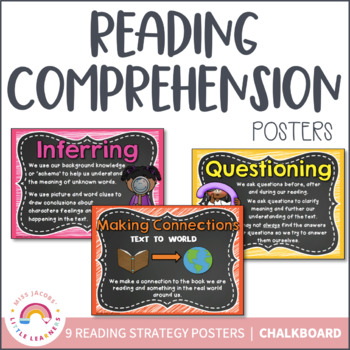
Reading comprehension strategy posters from Ms. Jacobs' Little Learners - $3.50
It's very hard to find a pretty set of these that uses British English spelling of visualisation and summarising. I think it would be worth spending this much on a set like this as it's something that's applicable to many class levels and it's a staple that you can refer to daily.


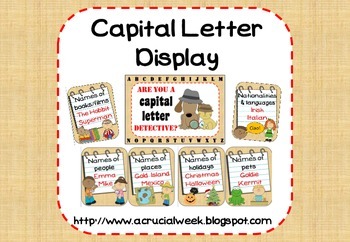
"Are you a capital letter detective?" display from A Crucial Week - $2.50
This one does as it says on the tin. It's a set of posters with reminders of when to use capital letters. It's a very useful point of reference for the children to use when self-correcting their writing.


...............................................
And when you've finished spending the price of a pint or you don't want to spend anything, check out these freebies to brighten up your classroom and create a print-rich environment.


These writing process posters, designed to be used as a clip chart were created and shared for free by The Teacher Wears Prada. I put the children's names on pencil clip art and stuck them to pegs. You can see how it looked in the photo below.


This giant pencil is from The Teacher Wife is famous online. You've probably seen it in a lot of classroom pictures on Pinterest. In fact, here it is in my classroom (along with the capital letter detective display from above):
 

This wonderful display of "criminal words" i.e. overused words such as "said," "went" and "walked" from Teacher's Pet.  You can download this for free here.


This very sweet owl-themed "I love reading!" poster is available for free at Kelly Benefield's TPT store.

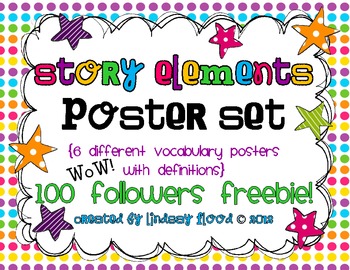
This story elements poster set from Primary Polka Dots would be fantastic for a younger or middle primary school class.

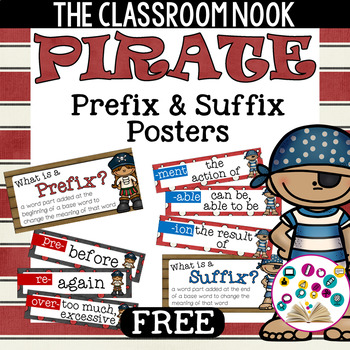
I'm definitely going to download this free prefix and suffix poster set from Rachael Parlett. It's a whopping 19 page set. Oh, and it's pirate-themed!


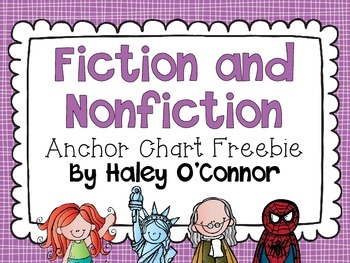
If you've got a young class, these are two very simple AND EXTREMELY ADORABLE posters to remind them about the difference between fiction and non-fiction. Thanks to Hayley O'Connor for sharing it for free.


Sunday, 22 March 2015

Unit of inquiry: Tell Tale

Hi all,

I've just finished my "How We Express Ourselves" unit of inquiry called "Tell Tale." Our central idea was "Ideas are expressed through stories and tales all around the world." It has been my favourite unit of inquiry to plan for and teach this year. 

Here's an idea of some of the things we did:
Week 1: Cinderella Around The World I- Revised the story of Cinderella, worked on character descriptions. We then listened to the story of "The Invisible Warrior" (also known as "The Rough Faced Girl") and conducted research into Native American culture. We also made some dream-catchers.

Week 2: Cinderella Around the World II - We looked at the story of Yeh Shen (Chinese Cinderella) and Rhodopis (The Egyptian Cinderella). We used Venn diagrams to compare the different versions of Cinderella and the children used investigation sheets to carry out research into Chinese and Ancient Egyptian culture. The children then created a costume for one of these Cinderellas inspired by their culture.


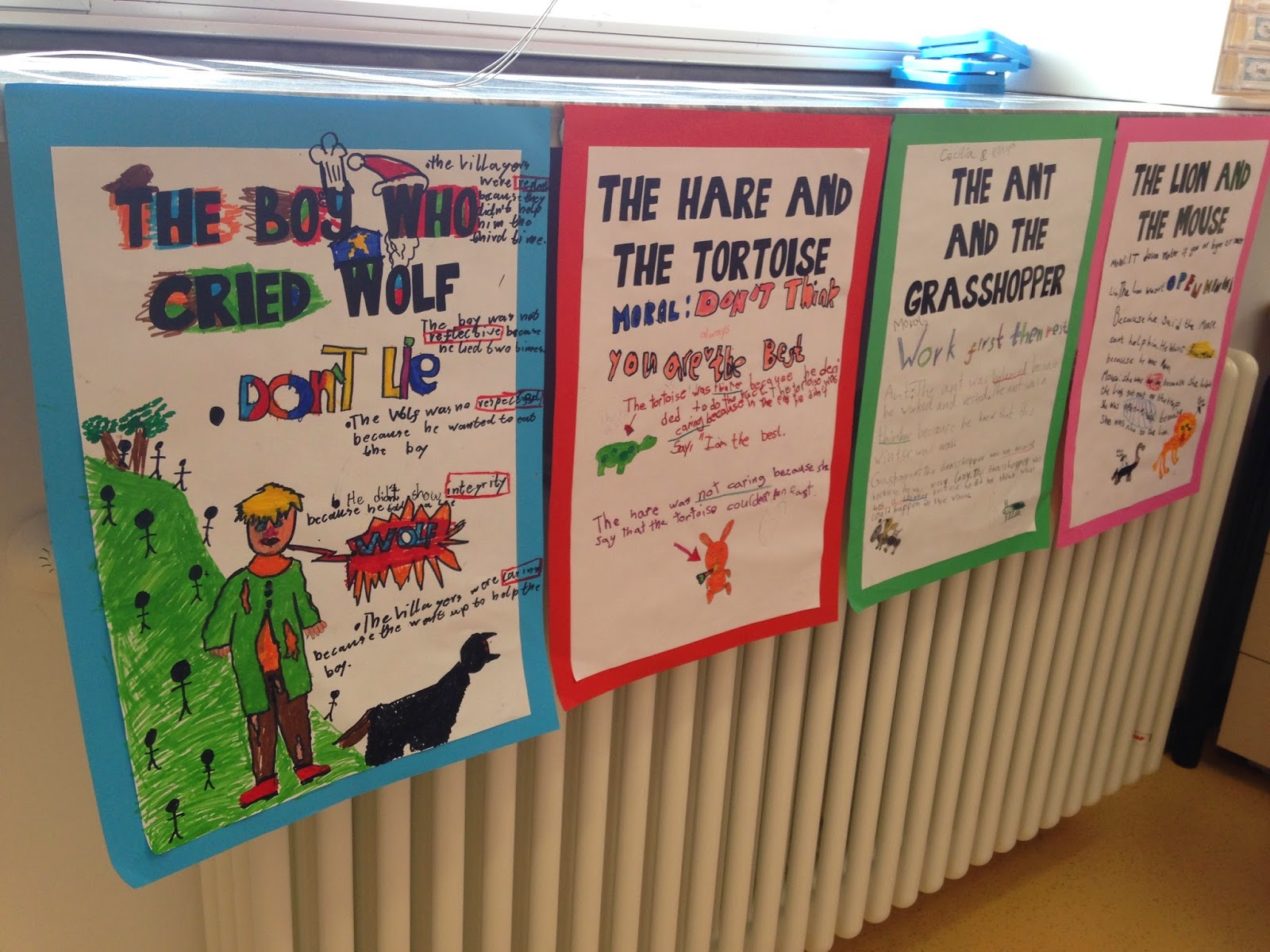
Week 3: Fables I- We looked at the difference between fables and fairytales and made posters to show the characteristics of both types of story. The children examined many fables. They worked on identifying the morals of stories, filling out story maps and writing their own version of "The Boy Who Cried Wolf."

Flashcards from Yvonne Dixon and nice/nasty character traits word mat from Sparklebox


Week 4: Fables II - We continued examining some more fables and discussing their applications in real-life situations. The children created another fable of their own based on "The Ant and the Grasshopper." They then created an animation of their own story using the iPad application, Puppet Palls HD. They purchased the "Directors' Pass" (in app purchase) so that they could design their own backgrounds and characters to include in their animation. The children then reflected on what Learner Profile attributes/PYP attitudes the characters did (or did not!) show!


Week 5: Folktales and legends - This week we focused on identifying cultural clues that tell us about where the stories were set. We looked at several stories from around the world and plotted the countries on a map. The children carried research into the culture behind these stories.

Week 6: Legends, assessment, reflection - For the final week of the unit, we looked at some Irish stories (it tied in nicely with St. Patrick's Day). The children then planned and carried out their summative assessment - to write an alternative version of a familiar story including elements of a culture of their choice. They made a plan, drafted, edited (using a self-assessment checklist), redrafted and illustrated their story. 

I hope this post is useful to anybody doing a fairytakes, folktales and fables theme or any IB PYP teachers doing a similar unit.

Saturday, 24 January 2015

Onomatopoeia and thesaurus ideas

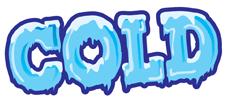
This week, in English, we have been learning about words that sound like their meaning (onomatopoeia) and words that look like their meaning (If anyone knows what that type of word is called, let me know in the comments below!).

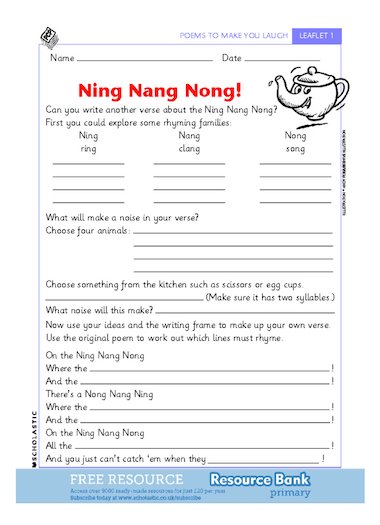
There are some fantastic onomatopoeia resources out there but sometimes it can be hard to choose from such a wide range. A colleague pointed me in the direction of "On The Ning Nang Nong" poem by Spike Milligan. I don't know how I hadn't heard this poem before. Even better, my colleague led me to The Children's Poetry Archive where there is an audio clip of Spike Milligan reading the poem with such amazing timing and expression. Guaranteed to be loved by children of any age and adults too! 

Better still, the wonderful people at Scholastic have created this worksheet to help the children to create their own verse to add to "On the Ning Nang Nong." You can download it for free from their website. (There's a slight mistake on the second last line of this worksheet. It should read "On the Nong Ning Nang.")

You could also have the children read the poem in groups using percussion instruments to add effect.


As for words that look like their meaning, I've found lots of examples to share with the children. 
Image source


I gave the children a list of words such as tall, big, small, cold, hot, wobbly. They then needed to use an online thesaurus to search for synonyms of these words and illustrate them like the above examples.


Tuesday, 20 January 2015

Free speech marks resources

As part of our "Signs and Symbols" unit of inquiry, my class has done lots of work on using punctuation to signify meaning. Last week we worked a lot on the use of speech marks (quotation marks). Here are some lesson ideas and resources that I used.

Visual reminders:
Having taught the rules about how speech marks, other punctuation and capital letters need to be used when the quotation is at the start or end of the sentence, we used these Gruffalo-themed posters (free to download from TES) to check over our work. I edited these slightly to use a different font and to make the important words bold and underlined.

I have also used these Ratatouille-themed posters (also free from TES) for older children in the past.


Tinipiny Camera iPad App:
I'm very lucky that all of the children in my class have an iPad. We had great fun working on speech marks using the free Tinipiny Camera Free (Balloons) app. There is also an Android version of this app. This app allows you to take a photograph and insert a speech bubble or a thought bubble. 

We used this app in a variety of ways. For the first lesson, I gave the children a sheet of sentences with quotations, finishing with "said," and one of the names of the children in the class e.g. "What time is it?" said Chloe. The children then had to find Chloe, take a photograph of her, isolate the speech and put it in a speech bubble.

When the children became more confident with how to write speech marks, I asked them to write a 4 or 6 part dialogue between them and a partner. They then used Tinipiny Camera to take photos of each part. The then put the photos side by side on Keynote to create a cartoon of their own dialogue. 


Creating own cartoons on paper:
This was an easy lesson to prepare. A quick Google search of "blank cartoon" will lead you to lots of comic strips. I created two different sheets for different ability levels. I used cartoons with lots of speech for one level and I used shorter cartoons (or cropped the last box off one I had already chosen) for other children. The class absolutely loved creating their own versions of what the characters were saying. They stuck this into their writing books and wrote the dialogue from the cartoon underneath.

Image source